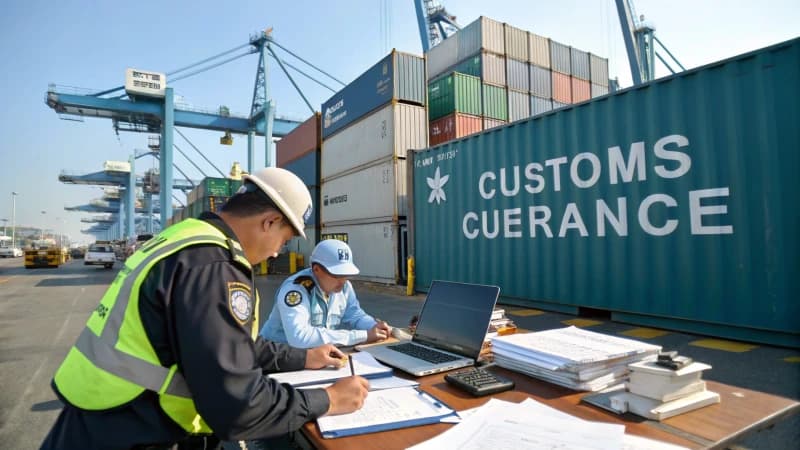
Customs clearance is one of the most misunderstood parts of international trade for Indian importers. Delays at the port or airport cost money in demurrage and detention, damage customer relationships, and — if left unmanaged — can result in goods being seized or returned. Yet with the right preparation and the right customs broker, clearance can be smooth and fast.
This guide explains the end-to-end customs process for importers in India, in plain language.
Who Controls Customs in India?
Customs in India is administered by the Central Board of Indirect Taxes and Customs (CBIC), under the Ministry of Finance. The Customs Act, 1962 is the primary legislation. All customs filing in India is done electronically through ICEGATE (Indian Customs Electronic Data Interchange Gateway).
Every importer also needs an Import Export Code (IEC) — a 10-digit number issued by DGFT (Directorate General of Foreign Trade). Without an IEC, you cannot legally import goods into India. Your GSTIN is also mandatory for most commercial imports.
Key Documents Required for Import Clearance
Gathering complete documentation before your goods arrive is the single most effective thing you can do to prevent delays. The standard documents required are:
- Bill of Lading (sea) or Air Waybill (air) — issued by the shipping line or airline
- Commercial Invoice — value, quantity, unit price, and buyer/seller details
- Packing List — detailed breakdown of packages, weights, and dimensions
- Certificate of Origin — mandatory for FTA claims; often required by customs regardless
- Insurance Certificate — especially for sea shipments
- Import Licence / Permit — for restricted goods (chemicals, electronics with BIS requirement, food products needing FSSAI NOC, etc.)
- MSDS (Material Safety Data Sheet) — for chemicals and hazardous goods
Additional documents may be required depending on your commodity — your customs broker will advise.
The Customs Clearance Process Step by Step
1. Filing the Bill of Entry
Once the shipping documents arrive, your Customs House Agent (CHA) files a Bill of Entry on ICEGATE. This is the formal declaration of your import consignment. The Bill of Entry includes:
- Importer IEC and GSTIN
- HS code (Harmonised System tariff code) for each item
- Declared value (CIF — Cost, Insurance, Freight)
- Country of origin
- Quantity and description
Getting the HS code right is critical. The entire duty calculation, and eligibility for any FTA benefits, depends on it. An incorrect HS code can result in a differential duty demand, penalties, or delays due to re-assessment.
2. Risk Management System (RMS) Assessment
After filing, ICEGATE's RMS (Risk Management System) assesses the consignment and assigns it to a channel:
- Green channel: The consignment is cleared without examination. Documents are assessed and duties are paid — goods are released.
- Yellow channel (first check): Only documents are checked by an officer. Goods are not physically examined.
- Orange channel: Documents and goods are examined.
- Red channel: Detailed examination of both documents and goods.
The majority of compliant importers with established track records are assessed green or yellow channel. First-time importers and high-risk commodities are more likely to be examined.
3. Duty Payment
Once the Bill of Entry is assessed, duties must be paid. Indian import duties typically include:
| Duty | What It Is |
|---|---|
| Basic Customs Duty (BCD) | The base import tariff, specific to the HS code |
| IGST | GST on the import value + BCD (18% for most goods) |
| Social Welfare Surcharge | 10% of BCD |
| Countervailing Duty / ADD | If applicable to the specific product and origin country |
Total effective duty varies widely by product — from 0% (capital goods under EPCG) to 40%+ for certain consumer products. Always get a duty assessment before committing to an import price.
4. Examination (if applicable)
If the consignment is selected for examination, a customs officer physically checks the goods against the packing list and invoice. Your CHA or a representative must be present. Examination at seaport CFS facilities can take 1–3 days.
5. Out-of-Charge Order (OOC)
Once all duties are paid and the consignment cleared, the system generates an Out-of-Charge (OOC) order. At this point, your goods are legally available for release from the CFS or airport terminal.
6. Delivery
Your CHA or logistics partner coordinates the actual physical handover of goods from the terminal to your truck. For seaports, this involves surrendering the original Bill of Lading (or a telex release) to the shipping line for a Delivery Order (DO) before goods can be collected.
Common Causes of Customs Delay (and How to Avoid Them)
❌ Incorrect HS Code
Fix: Work with a CHA who specialises in your product category. Request an advance ruling from CBIC if you are uncertain about classification for a new product.
❌ Missing Documents
Fix: Prepare your document checklist before shipment departs origin. Your freight forwarder should provide a commodity-specific checklist.
❌ Value Under-Declaration
Fix: Always use accurate transaction values on your invoice. CBIC has access to import price benchmarks and will query suspiciously low-valued goods.
❌ No Advance Bill of Entry
Fix: File an advance Bill of Entry (before the vessel arrives) for sea shipments — you can begin customs assessment even before goods arrive, getting a head start on clearance.
❌ Regulatory Permits Not Obtained in Advance
Fix: Identify any product-specific permits (BIS registration, FSSAI NOC, WPC type approval) before placing your import order. Some of these take weeks to obtain.
FTA Benefits: Reducing Your Duty Bill
India has Free Trade Agreements with ASEAN, UAE, Australia, Japan, South Korea, and others. If your goods originate in an FTA partner country and you have a valid Certificate of Origin in the correct FTA format, you can claim preferential duty rates — sometimes zero duty on products that would otherwise attract 15–20% BCD.
Always confirm FTA eligibility with your CHA before importing. The savings can be substantial.
Working With a Customs Broker (CHA)
A licensed CHA handles the filing, duty payment, and follow-up with customs on your behalf. Choosing the right CHA makes a significant difference:
- Experience with your commodity — a CHA who handles pharmaceutical imports is not necessarily the best choice for industrial machinery
- Port coverage — ensure your CHA is licensed and active at the port where your goods are arriving
- Speed and communication — delays from unclear instructions are avoidable if your CHA responds quickly and keeps you informed
At PrimePathCargo, our CHA team handles clearances at all major Indian seaports and airports. We provide a dedicated contact for each import, with proactive updates at each stage of the process.
Summary: Customs Clearance Checklist
Before your goods arrive:
- IEC is valid and active
- GSTIN is registered
- All import documents prepared (invoice, packing list, B/L or AWB, CoO)
- Product-specific permits obtained (BIS, FSSAI, WPC, etc.)
- HS code verified with CHA
- FTA eligibility checked
- CHA appointed and briefed
After goods arrive:
- Advance Bill of Entry filed (for sea)
- Duties calculated and funds ready
- Shipping line DO obtained
- Examination facilitated (if required)
- OOC received
- Delivery coordinated
Questions about your specific import? Contact our customs team — we are happy to review your documents and advise before you commit to your next shipment.